Choosing the Right Blood Pressure Cuff Size for an Upper-Arm Monitor
A cuff that is too small or too big can throw off a home blood pressure reading. Learn how to measure the arm, read the cuff label and check the fit.
When families buy a blood pressure monitor, they usually compare screens and buttons. The part that touches the arm gets less attention, yet the cuff size matters a great deal. A cuff that does not suit the arm can make readings look higher or lower than they should. This guide explains how to check the size before you buy and how to tell whether the fit is right at home.
Why cuff size matters
An upper-arm monitor works by inflating the cuff and sensing the pressure in the artery underneath. For that to work properly, the inflatable bladder inside the cuff needs to wrap around the arm the way the maker designed it. Too little bladder or too much, and the squeeze is uneven.
A cuff that is too small
A small cuff on a larger arm has to squeeze harder to do its job. Readings may come out higher than the person's real blood pressure. It may also feel uncomfortably tight, and the Velcro may keep popping open halfway through the measurement.
A cuff that is too large
A big cuff on a slim arm overlaps itself and wraps loosely. Readings can come out lower than they should. This is common with elderly parents who have lost muscle in the arms, especially after a long illness or hospital stay.
Why it matters for the doctor
The doctor uses home readings alongside clinic readings. If the home cuff is the wrong size, the home log may disagree with the clinic for no real reason. Getting the cuff right means the numbers you bring in are worth comparing.
Measuring the upper arm
You only need a soft tailor's tape, the kind found in most sewing kits. A metal tape from the toolbox will not wrap properly. Take the measurement on the arm you plan to use for readings.
Find the middle of the upper arm
Ask the person to sit and let the arm hang relaxed, or rest it on a table with the elbow slightly bent. Find the bony tip of the shoulder and the point of the elbow. The spot halfway between the two is where you measure.
Wrap the tape around
Wrap the tape around the arm at that midpoint. It should lie flat against bare skin, snug but not pressing in. Read the number where the tape meets and write it down. Do it twice to be sure; it is easy to pull the tape too tight on the first try.
A few practical tips
- Measure on bare skin, not over a sleeve.
- Keep the arm relaxed; a flexed muscle will measure larger.
- Measure both arms if the person might switch arms, and note both.
- Measure again if the person has gained or lost a lot of weight.
Reading the cuff label
Most cuffs have a printed range for arm circumference on the cuff itself or on the box. Some also show an index line and a range marker on the cuff, so you can see at a glance whether the fit is in range once it is wrapped.
Match the arm to the range
Compare the measurement with the range on the cuff. If the arm sits comfortably inside the range, the cuff should suit. If the arm sits right at the very edge, it is worth asking whether a different size is available for that model.
Standard, small and large cuffs
Many monitors come with a standard adult cuff, and some models offer larger or smaller cuffs separately. Cuffs are usually not interchangeable between brands because the connectors and tubing differ. Always check that a spare cuff is meant for your exact monitor.
When a cuff needs replacing
Cuffs wear out. Velcro loses its grip, the fabric frays and the tubing can crack where it bends. If the cuff no longer holds or the monitor keeps showing an error, a worn cuff is a common cause. Keep the box and booklet so you know which replacement cuff matches the monitor.
Checking the fit at home
Once the monitor arrives, try the cuff on before the first real reading. A proper fit only takes a minute to check, and it saves weeks of confusing numbers.
Signs of a good fit
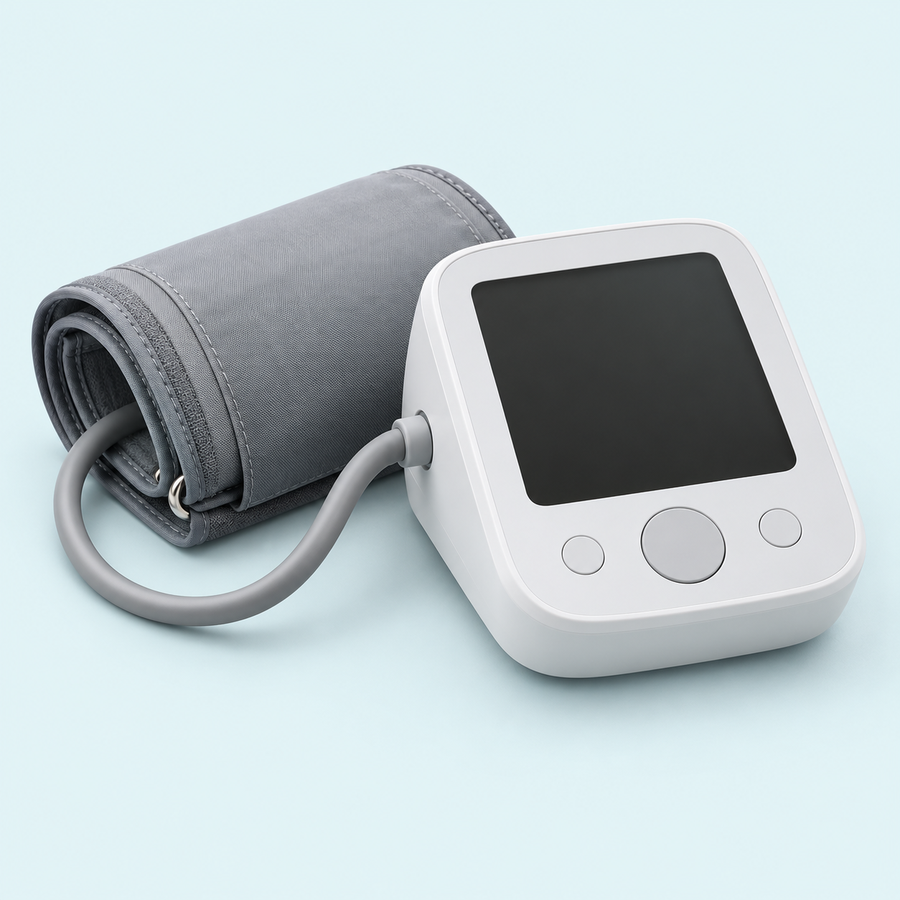
- The cuff sits on the upper arm, with its lower edge above the elbow crease.
- The marker lines up with the artery position shown in the booklet.
- You can slip one finger under the edge, but not much more.
- The Velcro holds firmly through the whole measurement.
- The index line falls inside the printed range, if the cuff has one.
Signs of a poor fit
Watch for a cuff that slides down towards the elbow, Velcro that barely overlaps, a cuff that folds over itself several times, or a person who winces every time it inflates. Any of these suggests the size or the wrapping needs another look.
When the person is bedridden
For a parent who mostly lies down, measure the arm in the same position you will take readings. Support the arm on a pillow so the cuff stays roughly level with the heart. Ask the clinic how they prefer readings to be taken in that position.
Getting the right cuff
Before ordering, take the arm measurement and keep it handy. It makes the conversation quick: we can check which cuff comes with the monitor and whether another size is available for that model.
Monitors and accessories we carry
Our blood pressure monitors include the Yuwell YE660D upper-arm monitor. Cuff sizes for the exact model are confirmed on WhatsApp before you order. You can browse the full catalogue for other home equipment, or read the buying guide if you are setting up care at home for the first time.
Delivery to your family
We deliver across Malaysia, from Petaling Jaya to Ipoh and Kota Kinabalu. If you are buying for a parent in another state, send us their arm measurement and we will check the cuff before it ships.
This article is general information, not medical advice. Ask the clinic if you are unsure how readings should be taken.
Have the arm measurement ready? Send it to our team on WhatsApp: Check Cuff Size